Interest rates are everywhere—in your mortgage, your car loan, your savings account and your investment portfolio. Yet they can often feel like a mysterious force, driven by headlines about the Federal Reserve, inflation or sudden movements in Treasury yields.
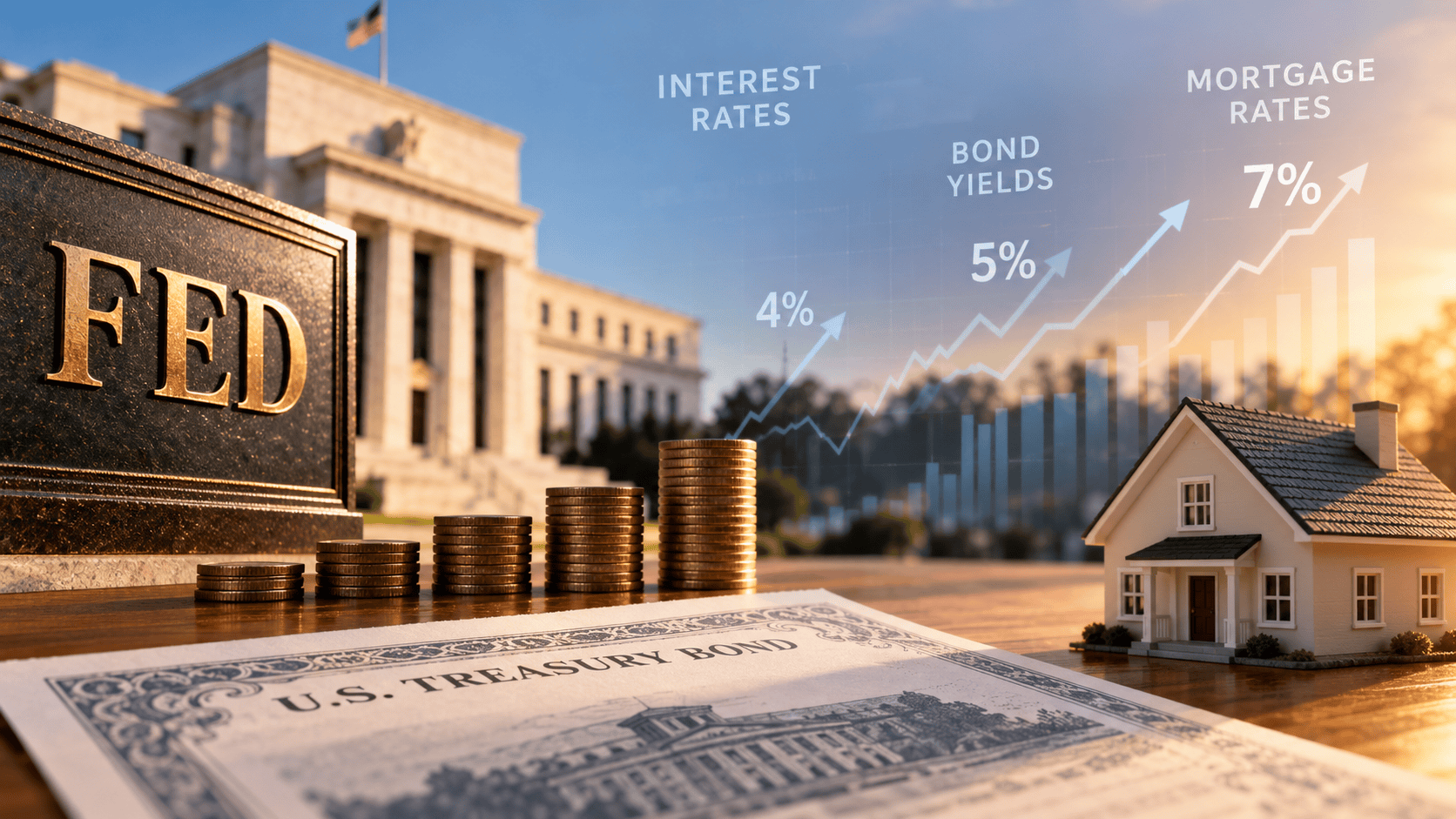
For investors, understanding how interest rates work has become especially important in 2026. Long-term Treasury yields have risen to levels rarely seen in nearly two decades, mortgage rates are once again above 7%, and the Federal Reserve continues to wrestle with inflation that remains above its target.
At the same time, higher yields have created something investors haven’t enjoyed for much of the past 15 years: the ability to earn meaningful income from high-quality bonds.
To understand the opportunity—and the risks—it helps to first understand how the Federal Reserve influences interest rates, why bond yields move and why the Fed does not actually control many of the rates consumers and investors see every day.
The Federal Reserve and Its Dual Mandate
When financial news outlets talk about a “Fed meeting” or a change in interest rates, they are usually referring to the federal funds rate. This is the overnight interest rate the Federal Reserve targets for lending between banks.
The federal funds rate is not the rate you pay on your mortgage or the yield you receive on a 10-year Treasury bond. But it serves as an important foundation for short-term interest rates throughout the economy.
Why does the Fed change rates?
The answer begins with what is known as the Federal Reserve’s dual mandate: maximum employment and price stability.
Those two objectives can sometimes point monetary policy in the same direction. If the economy is weakening, unemployment is rising and inflation is low, the Fed may be able to lower rates to support economic activity.
The more difficult situation occurs when inflation remains too high while the labor market and economy remain relatively strong. Lowering rates may stimulate the economy and employment, but it can also reignite inflation. Raising rates can help control inflation, but eventually risks slowing the economy and employment.
That tension is particularly relevant today.
At its September 2026 meeting, the Federal Reserve raised its target range for the federal funds rate by 0.25 percentage point, to 3.75%–4.00%. The Fed noted that economic activity continued to expand at a solid pace and unemployment had changed little, while inflation remained elevated.
In other words, with employment relatively healthy, inflation remains the more immediate challenge facing policymakers.
That is an important distinction for investors waiting for significantly lower interest rates. The Fed’s decisions will continue to depend on the incoming inflation, employment and economic-growth data rather than simply on the fact that borrowing costs already feel high.
The Fed Doesn’t Control Every Interest Rate
One of the most important concepts for investors to understand is that the Federal Reserve does not directly set the 10-year Treasury yield or the 30-year mortgage rate.
The Fed has much greater influence over the short end of the yield curve. Rates on Treasury bills, money-market instruments and other short-term investments tend to respond relatively quickly to changes in Fed policy.
Long-term rates are different.
The 10-year and 30-year Treasury yields are determined in the bond market and reflect investors’ expectations about future inflation, economic growth, future Federal Reserve policy and the compensation investors require for lending money for long periods.
Supply and demand matter as well. Large federal budget deficits require the Treasury to issue substantial amounts of debt. If investors require higher yields to absorb that supply, long-term interest rates can rise even without a corresponding increase in the federal funds rate.
This helps explain an important feature of today’s market: the Fed’s policy rate can be below 4% while the 10-year Treasury yields more than 5%.
The Fed controls one important interest rate. The bond market determines many of the others.
Understanding the Yield Curve
The yield curve plots the interest rates of U.S. Treasury securities with different maturities, ranging from short-term Treasury bills to 10-, 20- and 30-year Treasury bonds.
Normally, investors expect to receive a higher interest rate for lending their money for a longer period. Under those circumstances, the yield curve slopes upward.
But that relationship can change.
During the Fed’s aggressive inflation-fighting campaign beginning in 2022, short-term interest rates rose dramatically. For a period, short-term Treasury securities yielded more than longer-term bonds, producing what is known as an inverted yield curve.
Historically, an inverted yield curve has often preceded economic slowdowns or recessions. But it is important to remember that the yield curve is an indicator, not a guarantee of a particular economic outcome.
The situation in 2026 looks different.
Long-term yields have risen significantly. The 10-year Treasury was approximately 5.17% in late September, while the 2-year Treasury was approximately 4.8%. The curve is no longer telling the same story it was during the deeply inverted period of several years ago.
Today, investors are demanding substantial compensation to lend money for longer periods. Persistent inflation, resilient economic growth, government borrowing and uncertainty about the future path of interest rates are all contributing to higher long-term yields.
Why Bond Prices Fall When Interest Rates Rise
At its most basic level, the relationship between bond prices and interest rates works like a seesaw:
When interest rates rise, existing bond prices generally fall. When interest rates fall, existing bond prices generally rise.
Suppose you own a bond paying 3%, and newly issued comparable bonds suddenly pay 5%. An investor would have little reason to pay full price for your 3% bond when a new one pays 5%. The market price of your bond therefore falls until its effective yield becomes competitive.
This is why 2022 was such a difficult year for bond investors. Rates increased rapidly, causing the market value of existing lower-yielding bonds to decline.
But there is another side to that story.
Those same rate increases that hurt existing bond prices eventually create higher future income for bond investors. Today’s investor can purchase high-quality bonds at yields that would have seemed extraordinarily attractive just a few years ago.
That is one reason the bond market deserves a fresh look in 2026.
Why Is the 10-Year Treasury Above 5%?
The 10-year Treasury yield moving above 5% is significant because that rate influences borrowing costs throughout the economy.
Several forces can push long-term yields higher.
Inflation is perhaps the most obvious. If an investor is lending money for 10 years, the purchasing power of the dollars ultimately received matters. Higher expected inflation generally means investors demand a higher yield.
Economic growth also matters. A resilient economy can keep demand strong and make inflation more difficult to bring down, potentially keeping rates higher for longer.
Federal borrowing and Treasury supply are increasingly important. Large government financing needs mean more Treasury securities must be absorbed by investors. Greater supply can require higher yields to attract sufficient buyers.
Finally, investors require compensation for interest-rate uncertainty. Buying a 10- or 30-year bond means committing capital for a long time. The greater the uncertainty surrounding inflation and future rates, the greater the return investors may demand.
This is why a decline in the federal funds rate does not necessarily guarantee an equivalent decline in the 10-year Treasury.
Why Mortgage Rates Are Back Above 7%
The relationship between Treasury yields and mortgages provides a real-world example of the difference between Fed policy and market interest rates.
As of late September 2026, the average 30-year fixed mortgage rate was approximately 7.03%.
Mortgage rates tend to be more closely connected to longer-term market rates than to the federal funds rate. Consequently, homeowners can hear discussions about eventual Fed rate cuts and reasonably wonder why mortgage rates remain so high.
The answer is that lowering the federal funds rate does not automatically lower long-term Treasury yields.
If investors remain concerned about inflation, government borrowing or future economic growth, the 10-year Treasury can remain elevated. Mortgage rates can remain elevated along with it.
For consumers, the difference is substantial. A mortgage rate above 7% dramatically increases the monthly payment associated with buying a home compared with the 3%–4% mortgages available only a few years ago. That can reduce affordability, discourage existing homeowners from moving and slow activity in interest-rate-sensitive areas of the economy.
Those effects are also part of what the Fed watches when determining future monetary policy.
What Does This Mean for the Fed’s Next Decisions?
The Fed now faces an interesting balancing act.
Inflation remains above its 2% objective, which argues for maintaining enough restraint to keep inflation moving lower. At the same time, elevated long-term rates and mortgage rates are already creating tighter financial conditions throughout the economy. We can debate whether a 2% mandate is too low, but that is the current Fed target and does not look to be changing.
That means the Fed has to consider more than simply the level of its own overnight rate.
If long-term Treasury yields and mortgage rates remain elevated, financial conditions may stay restrictive even without additional large increases in the federal funds rate.
If inflation continues to decline while employment begins to weaken, the employment side of the Fed’s dual mandate could become more important and create greater room for lower rates.
Conversely, if economic growth remains resilient and inflation proves stubborn, the Fed may have less flexibility to reduce rates—and long-term yields could remain higher for longer.
For investors, trying to predict every Fed meeting is probably less important than building a portfolio capable of functioning under several of these outcomes.
So, How Should Investors Think About Bonds Today?
For much of the decade following the financial crisis, the challenge with bonds was simple: yields were extremely low.
Today’s challenge is different.
Investors can earn attractive income again, but they must decide how much interest-rate risk—or duration—they want to accept to get it.
Duration measures a bond’s sensitivity to changes in interest rates. Longer-duration bonds generally rise more when rates fall, but they also decline more when rates rise.
That creates several opportunities worth considering.
Short-term bonds and Treasury bills can still provide attractive income with relatively little interest-rate sensitivity. They can make sense for cash needs, near-term spending or investors who want to limit volatility.
However, there is a tradeoff. An investor who stays entirely in very short maturities faces reinvestment risk. If the Fed eventually lowers short-term rates, today’s attractive short-term yields may disappear quickly as those securities mature.
Intermediate-term bonds can offer a middle ground. Investors can lock in today’s higher yields for longer while taking a moderate amount of duration risk. If inflation continues to decline and market yields eventually move lower, intermediate bonds could also benefit from price appreciation in addition to their interest income.
Long-term bonds offer the greatest sensitivity to falling rates—but also the greatest risk if long-term yields continue to rise. With the 10-year Treasury already around 5%, extending duration may be attractive for some investors, but doing so is also a more significant bet on the future direction of inflation and interest rates.
That argues against treating today’s bond market as an all-or-nothing decision.
Bonds Can Play Their Traditional Role Again
Perhaps the biggest change in fixed-income investing is that investors no longer necessarily need to take substantial credit risk simply to generate income.
Treasuries, investment-grade corporate bonds, municipal bonds for appropriate taxable investors and other high-quality fixed-income securities can now offer meaningful yields.
For retirees and investors drawing income from their portfolios, that can be particularly valuable.
Higher starting yields can also provide a cushion against future interest-rate increases. And if economic growth eventually slows enough to push interest rates lower, intermediate- and longer-duration bonds may provide capital appreciation at a time when other parts of a portfolio are under pressure.
This does not mean investors should abandon stocks or move aggressively into long-term bonds. It means bonds can once again perform several jobs within a portfolio: generate income, preserve capital, provide diversification and potentially appreciate when economic conditions weaken and rates decline.
The Bottom Line
The interest-rate environment of 2026 is very different from both the near-zero-rate world that followed the financial crisis and the aggressive Fed tightening cycle that began in 2022.
The Federal Reserve is balancing its dual mandate of price stability and maximum employment. Inflation remains above target, the economy and labor market have remained resilient, long-term Treasury yields are above 5%, and mortgage rates have moved back above 7%.
For consumers, that means borrowing remains expensive.
For investors, however, there is another side to the story: fixed income is offering meaningful income again.
The key is understanding that the Fed controls short-term policy rates while the market determines longer-term yields. The two can move in different directions.
Rather than trying to predict exactly when the Fed will make its next move, investors may be better served by asking a different question:
Are we being adequately compensated for the interest-rate risk we are taking?
At today’s yields, the answer in many parts of the high-quality bond market looks considerably different than it did just a few years ago.
Fixed income does not need to be viewed simply as the conservative portion of a portfolio. Used thoughtfully, bonds can be an important source of income, stability and opportunity—particularly in an interest-rate environment as unusual as the one investors face today. Bonds are just one part of a properly diversified portfolio and all decisions need to be based on the whole picture tied to your particular situation, goals, risk tolerance, and time horizon.
Conclusion
Understanding the basics of interest rates, how the Fed makes decisions, and how these choices send shockwaves through bond and mortgage markets is more important than ever in today’s dynamic environment. These rate changes affect real-world decisions—whether you can comfortably afford your mortgage, how much your investments earn, and even how much groceries may cost down the line. Staying knowledgeable is your best defense.
As you watch news of rising or falling rates and wonder what it means for you, remember that you do not have to navigate these waters alone. If you want personalized advice tailored to your financial situation and goals, reach out to Bestgen Wealth Management via our contact page. Let us help you make sense of rates, Fed decisions, and what comes next—so your finances stay strong, no matter how the yield curve bends.