
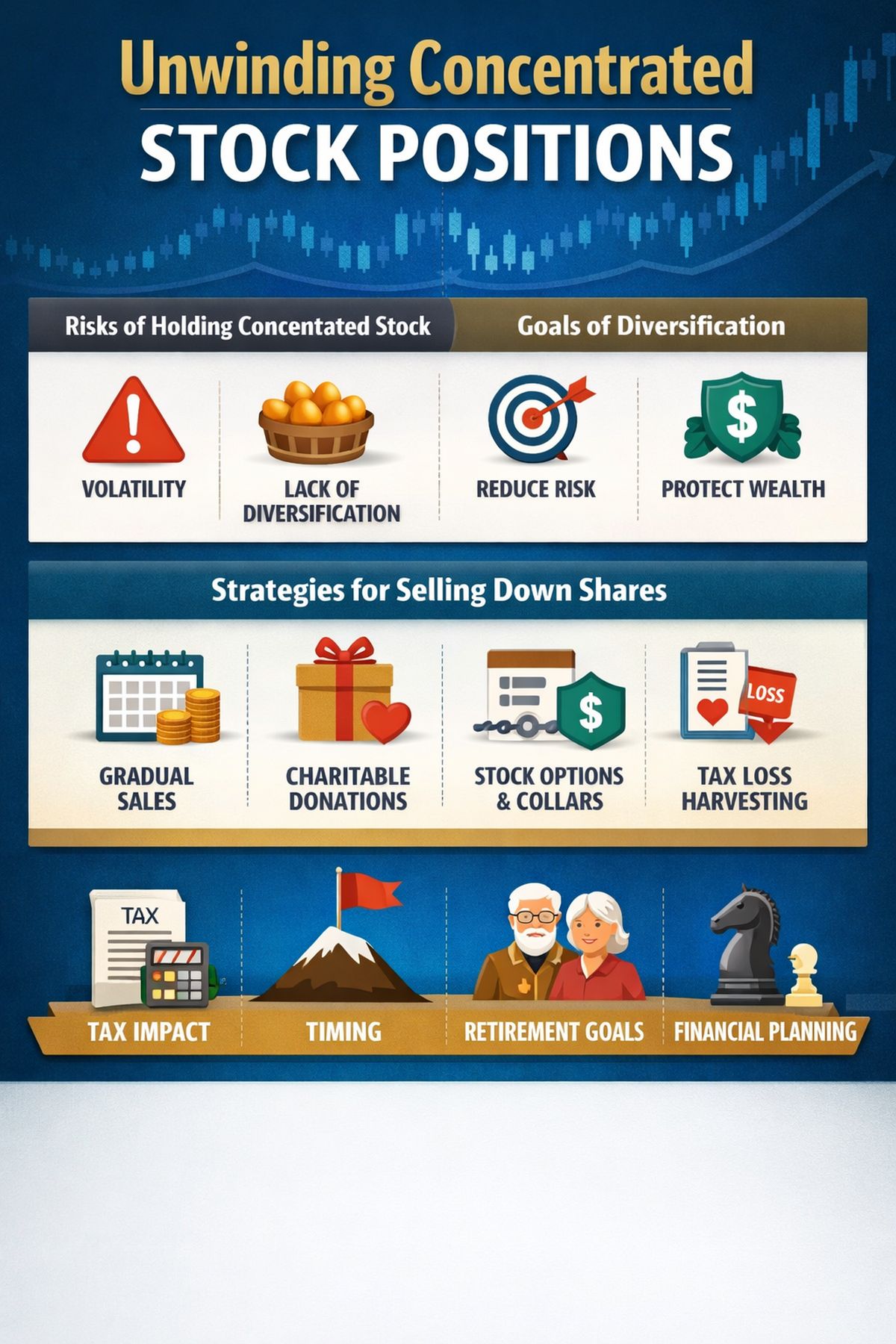
Unwinding a highly concentrated stock position, what options do I have?
While having built a large position and created wealth for your family in one stock is a nice issue to have, unwinding it to meet your objectives should not be taken lightly. While we don’t recommend letting the tax tail wag the dog in all planning decisions, if you can minimize tax and achieve the desired outcome keeping more in your families pocket why wouldn’t you?
A large, concentrated stock position can be a double-edged sword. If you are an executive or high net worth investor, you likely worked hard or invested wisely to amass a significant holding in one stock—whether it’s from restricted stock units, founder’s equity, an early-stage investment or a gift from family. But as that position grows, so does your exposure to single-stock risk, and the challenge of selling out without taking a tax hit becomes increasingly complex. Fortunately, with careful planning and the right toolkit both tax efficiency and portfolio diversification are within reach.
Below we will outline a few, not all, strategies for managing a concentrated position . The first step is to understand your goals and what the ultimate purpose is for the money. A big part of the decision will depend on what percentage of your liquid and overall net worth this position represents.
Charitable strategies such as Charitable Remainder Trusts (CRTs) or Donor-Advised Funds (DAFs) allow investors to donate appreciated stock, avoid capital gains taxes on the sale, and receive charitable deductions. CRTs can also provide an income stream, while DAFs offer flexibility in distributing charitable gifts over time.
Exchange funds allow investors to contribute concentrated stock to a pooled investment fund and receive ownership in a diversified portfolio without triggering immediate gains taxes. After the required holding period, investors receive a diversified basket of stocks.
Section 351 transactions involve contributing shares into a corporate structure in exchange for ownership in the new entity. This allows diversification while deferring taxes, although the structure can be complex and typically suits ultra-high-net-worth investors.
Options strategies, such as protective puts or collars, can help reduce downside risk without selling the stock. While these strategies can hedge risk, they do not provide diversification and are often used as temporary solutions while a longer-term plan is developed.
In many cases, the most effective approach combines several strategies. For example, an investor might hedge risk with options, donate some shares to a donor-advised fund for tax efficiency, and place another portion into an exchange fund for diversification.
Comparing the Strategies: Tax Efficiency, Diversification, or Both?
Some of these strategies excel at diversification (like exchange funds), others at tax minimization (charitable trusts, DAFs), and a few can provide a blend (e.g., Section 351 transactions). How do you choose?
Trade-Off Overview
| Strategy | Diversification | Tax Deferral/Avoidance | Philanthropic Opportunity | Complexity |
|---|---|---|---|---|
| Charitable Trust (CRT) | Yes | Yes | Yes | High |
| Section 351 | Yes | Yes (deferral) | No | High |
| Exchange Funds | Yes | Yes (deferral) | No | Medium |
| Donor-Advised Fund (DAF) | Partial | Yes (avoidance) | Yes | Low |
| Options/Collar | No | N/A | No | Low/Med |
Some solutions, like CRTs and exchange funds, offer both diversification and significant tax advantages. However, you must balance control, timing, liquidity, and philanthropic goals. For example, a DAF provides the best deduction flexibility but not always instant diversification. Meanwhile, exchange funds require patience with their holding periods.
Blended Approaches
Savvy investors often combine several strategies. Consider using options to hedge risk while deploying staged sales to a DAF for tax-savvy charitable giving, and allocating a remaining block to an exchange fund for broader diversification. Synchronizing these approaches delivers maximum benefit.
It should also be remembered none of these are all or nothing, which is how many people look at this situation. Perhaps you have sentimental ties to the stock or it is a company you feel will do well and you want to continue to own it. That is ok. Anyone of the strategies mentioned can be done with a portion of the stock while still maintaining a portion of your original position.
Key Takeaways
- Concentrated stock positions are risky for executives and high net worth individuals, and unwinding them in a tax-smart way is essential for long-term wealth.
- Charitable trusts and DAFs provide powerful vehicles for tax-efficient diversifications aligned with philanthropic objectives.
- Section 351 and exchange funds offer instant diversification and tax deferral by pooling assets, but require careful structuring and patience.
- Options and collars are effective for temporary risk reduction, though they do not inherently provide diversification or address capital gains.
- No single solution is best for everyone—trade-offs abound. Many successful strategies blend several tactics to optimize for both tax efficiency and diversification.
- Engage a qualified wealth advisor like Bestgen Wealth Management to tailor a plan to your profile and objectives.
Conclusion: Your Path to Tax Efficiency and Diversification Starts Here
Unwinding a highly concentrated stock position is never simple, but you do not have to choose between heavy tax bills and single-stock risk. By leveraging advanced strategies, savvy investors can achieve both tax efficiency and greater diversification. Each solution comes with its own benefits and constraints, and the optimal plan blends the tools that best fit your unique goals, risk tolerance, and time horizon.
If you are ready to explore which of these approaches will best protect and grow your wealth, our team at Bestgen Wealth Management is here to help. From evaluating your situation to implementing complex structures and monitoring results, we are your partner for every step of the journey. Contact us today at Bestgen Wealth Management to begin designing your personalized, tax-smart diversification strategy.
Your financial security—and legacy—deserve nothing less.
Advisory services offered through Commonwealth Financial Network, a Registered Investment Adviser.